- france
- macron
- protests
- public-debt
- political-trust
France protests expose a state that cannot pass a budget
Two reported deaths, a burned town hall and more than 3,000 looted shops were met with curfews and talk of a state of emergency. What the French government cannot police away is fiscal and parliamentary.
6 min read
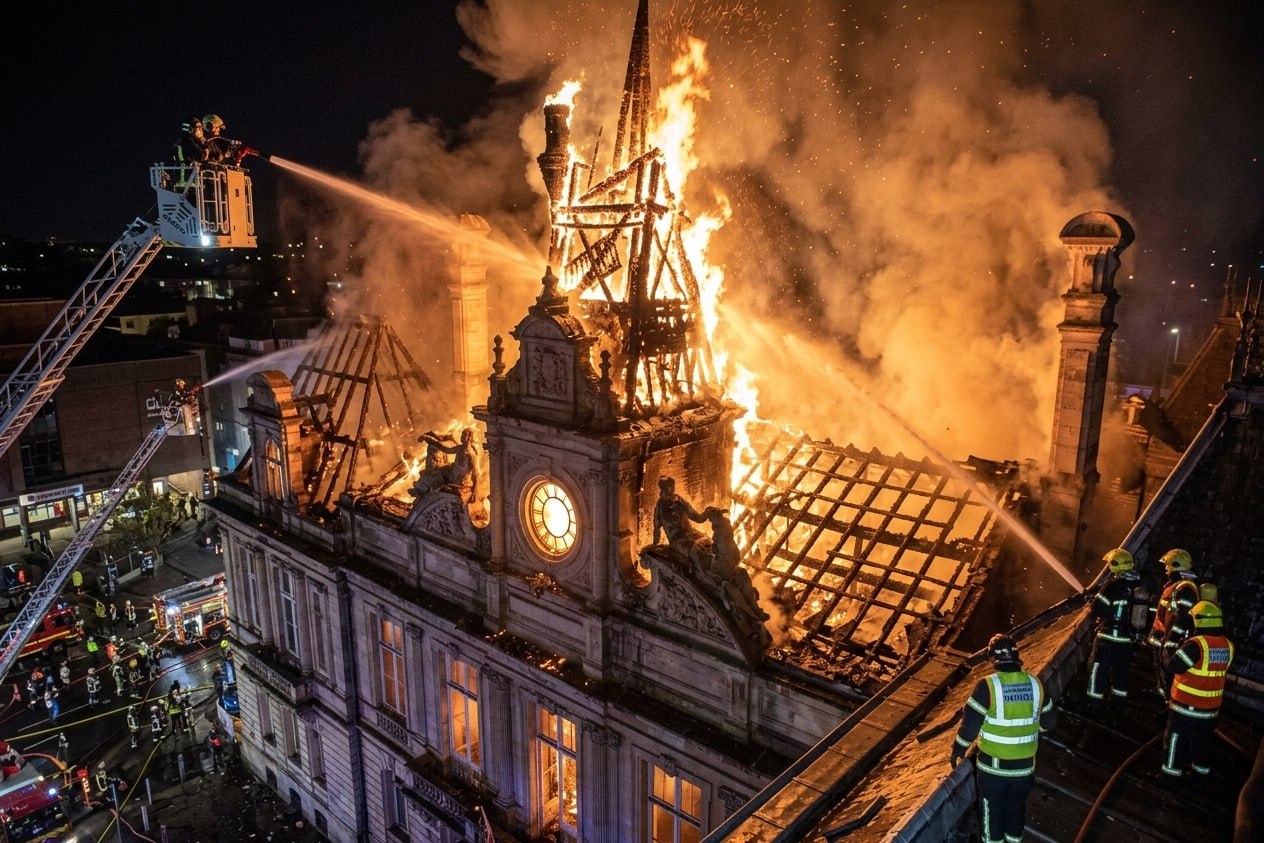
On Monday, October 19, 2026, Prime Minister Sébastien Lecornu convened a crisis meeting. Municipalities were asked to impose partial curfews. A state of emergency was left on the table but not ruled out. That was the government's answer to a weekend described as the worst unrest in France since May 1968, in which two people were reported dead, Limoges town hall was set on fire and more than 3,000 shops were looted or damaged, according to government figures cited by Reuters (US News).
It is worth being precise about what those instruments do. A curfew moves people off the street. A crisis meeting coordinates ministries. A state of emergency widens police powers and lets authorities restrict movement. None of them lowers a price, restaffs a hospital ward or passes a budget. The France protests of October 17–18 were met with a public-order toolkit because that is the toolkit the state still controls. The part it does not control is the parliamentary arithmetic behind the budget, and that is the part the weekend was really about.
A weekend counted in detentions, injuries and burned buildings
The detention and injury numbers diverge. Euronews' bulletin of October 19 reported around 2,400 people detained and close to 1,000 police officers and emergency workers injured (Euronews). Government figures cited by Noticias RCN put detentions at close to 2,000 and injuries among police and firefighters at more than 600 (Noticias RCN). Both sets are attributed to officials rather than to a published statistical document, so they should be read as briefings that may still be revised. The death toll of two rests on a single source among those available here, Middle East Eye, and is not corroborated elsewhere (Middle East Eye).
Material damage is the least disputed record: Limoges town hall burned, more than 3,000 shops pillaged or damaged, per the French government as cited by Reuters. That asymmetry matters. The physical record is visible and countable; the political meaning is contested, and the first battlefield is the count itself.
The unrest also crossed borders. Blu Radio reported protests linked to the same wave in Milan, Belgium, Portugal and Albania (Blu Radio). A grievance that spreads along the same cost-of-living script is harder to file away as a French policing problem.
A coalition with nobody sitting at the table
Reported accounts describe a heterogeneous crowd, mobilized above all around the cost of living and underfunded public services, with students among the most visible contingents (US News; Euronews). That breadth is the movement's strength in the street and its weakness anywhere a negotiation could happen. There is no single demand a government can accept or refuse, and no spokesperson entitled to sign anything on the crowd's behalf.
This hands the executive a choice it has every incentive to make badly. Naming the violent minority as the face of the protest is simpler than finding an interlocutor inside a coalition that has none. It also converts a social and fiscal question into a policing one before any talks begin.
Even the electoral reading outruns the evidence. Eugénie Richard, a doctor in social studies at Universidad Externado, notes that both the left and the right are trying to capitalize on the discontent while cautioning that it is not yet possible to establish which political current would benefit (Noticias RCN). Anyone presenting the unrest as an automatic gift to one camp is guessing.
Curfews in four cities and a minister who stays in place
Partial curfews were announced in areas of Paris, Marseille, Toulouse and Lyon after looting, vandalism and clashes with police (Blu Radio). President Emmanuel Macron said he felt "anger and shame" over Saturday, October 17, and warned that those responsible would be held accountable, according to the same broadcast.
More revealing is the personnel decision. Macron acknowledged "failures of anticipation and intelligence" after the riots but rejected the resignation of Interior Minister Laurent Nuñez, the Élysée said (Euronews). A minister stays in place while his ministry's intelligence failure is conceded in public. That is a choice to absorb blame at the top rather than reopen the chain of command in the middle of a crisis, and it leaves the government's security doctrine unchanged.
"Far-left fringe groups and criminals": what the label spares the Élysée
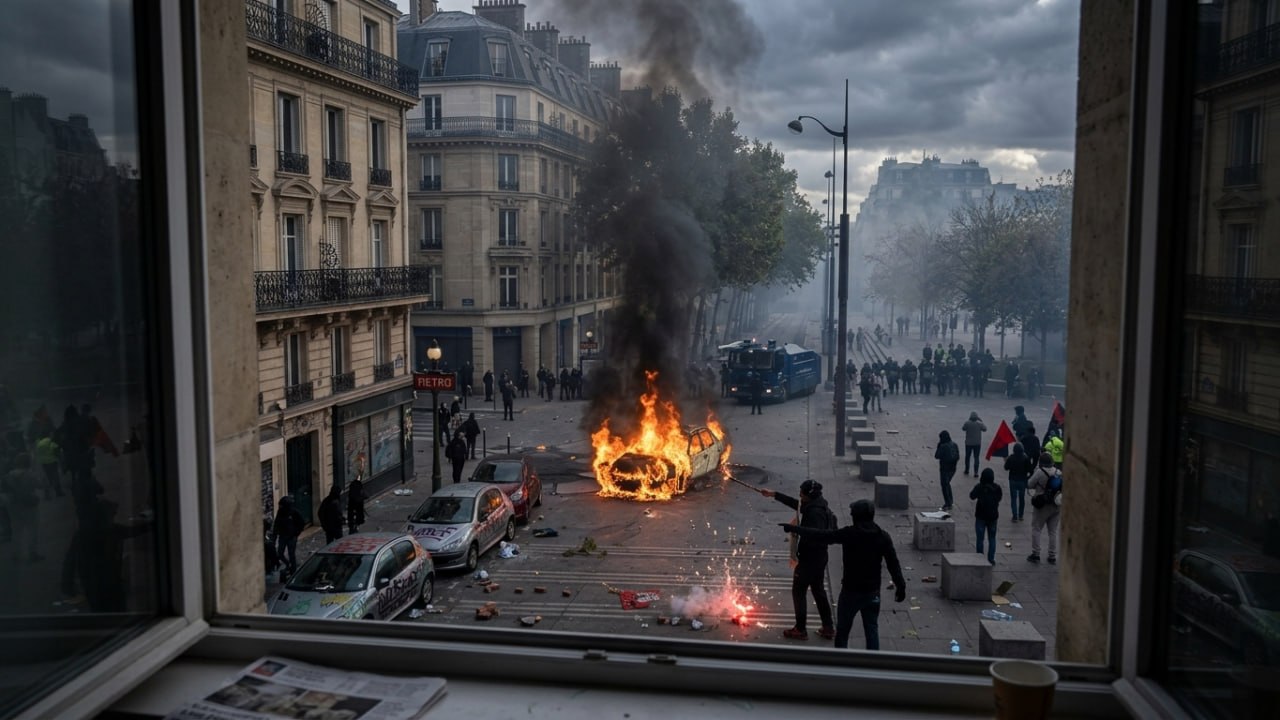
Macron attributed the unrest to "troublemakers from far-left fringe groups joined by numerous criminals," according to Middle East Eye. The claim remains unverified: nothing in the available reporting establishes who organized the violence, or in what proportion. It may also be partly true and still work as a framing device. Its function is to move the file from social policy to policing, and to set the terms of any future negotiation before negotiation starts.
It sits awkwardly beside the president's own admission of intelligence failures and his refusal to accept his interior minister's resignation. A government that says it did not see the weekend coming is simultaneously claiming to know precisely who composed it.
Two things can be true at once, and the distinction is worth keeping. The arson in Limoges, the looting recorded by the government and the injuries among police and firefighters are documented. None of that requires anyone to accept that the protests were, in essence, a criminal enterprise. A minority can cause the damage without defining the whole. The consequence of collapsing the two is mechanical: a criminal diagnosis produces a curfew, while a social and fiscal diagnosis would produce a budget and a negotiation.
The 98%-to-119% number behind the barricades
El País reports that French public debt rose from 98% to 119% of GDP across the nine years of Macron's presidency (El País). Debt-to-GDP compares what a state owes with what its economy produces in a year; the higher the ratio, the larger the share of future output already spoken for. It is not a household credit card, but it is a constraint, and it tightens when borrowing gets more expensive.
The external context is doing exactly that. Eurozone inflation more than doubled during 2026 and the European Central Bank had already raised interest rates twice, with another increase still possible before year-end (Euronews).
The political constraint is as tight as the fiscal one. El País reports that La France Insoumise and the Rassemblement National are now the two largest forces in Parliament. Political scientist Pascal Perrinau describes "a crisis of political confidence," citing record unpopularity for the president and a prime minister unable to pass the budget, and expects a presidential campaign oscillating between indifference and support for the protest parties. This is why the France protests are hard to answer rather than merely hard to police. Any concession costs money the state must borrow at rising rates, and it would need approval from the same parliamentary arithmetic that produced the deadlock in the first place.
What a serious answer would require
The record leaves real gaps. It does not show what specifically turned demonstrations into riots, who the two dead were or under what circumstances, whether a state of emergency was ever formally declared, which municipalities actually imposed curfews and for how long, or whether the government has opened talks with any union or student group. The fate of the budget after the crisis meeting is also unrecorded, and it is the single item that would indicate whether the government intends to address causes or only consequences.
Those gaps are not neutral. A government that communicates through counts and curfews is also a government that has not named an interlocutor, and without one there is nothing to negotiate even if the money were found.
The test is not whether the curfews hold this week; barricades come down. It is whether anyone in Paris can put a figure on the table that both the street and the Parliament will accept. On the available evidence, that figure does not yet exist — and the burned town hall in Limoges is what its absence looks like.
Frequently asked questions
+What happened during the France protests of October 17–18, 2026?
Large demonstrations over the cost of living and underfunded public services turned into riots and looting across French cities. Limoges town hall was set on fire and more than 3,000 shops were looted or damaged, according to government figures cited by Reuters. Two deaths were reported. Around 2,400 people were detained in one count; government figures cited elsewhere put it near 2,000.
+Why are there curfews in Paris, Marseille, Toulouse and Lyon?
Prime Minister Sébastien Lecornu asked some municipalities to impose partial curfews after the weekend's looting, vandalism and clashes with police, and did not rule out a state of emergency. Local curfews are a public-order measure: they clear the streets but do not address prices, public services or the budget deadlock that drove the protests.
+Why can't the French government simply meet the protesters' demands?
French public debt rose from 98% to 119% of GDP during Macron's presidency, and the European Central Bank had already raised rates twice in 2026, with another rise possible. Any new spending must be borrowed at higher cost and approved by a Parliament where La France Insoumise and the Rassemblement National are the two largest forces.
+Did far-left groups and criminals cause the violence?
Macron blamed "troublemakers from far-left fringe groups joined by numerous criminals," but no available reporting establishes who organized the violence or in what proportion. The claim is unverified rather than refuted. Arson and attacks on police are documented facts; whether they defined the whole protest is a separate and contested question.
Sources
The claims in this article are backed by these sources:
- ¿Qué es lo que está pasando en Francia? Experta explica las razones detrás de las protestas y la crisis social | Noticias RCN · noticiasrcn.com
- EURONEWS HOY | Las noticias del lunes 19 de octubre: Francia sumida en el caos por las protestas · youtube.com
- Francia prende fuego al macronismo | Internacional | EL PAÍS · elpais.com
- Francia fuera de control: saqueos, disturbios y toques de queda en varias ciudades · youtube.com
- French authorities struggle to regain control after deadly weekend of protests | Middle East Eye · middleeasteye.net
- Explainer-France in Turmoil: What Might Follow a Weekend of Riots? · usnews.com
- 🚨 Qué está pasando hoy en Francia (17 octubre 2026) ... · facebook.com
- 17 de octubre de 2026. Francia enfrenta una escalada de ... · instagram.com